Peter Partner, The Murdered Magicians:
“From its beginnings, which only shortly antedated Ramsay’s intervention in 1736, French Masonry had been patronized by the highest aristocracy; this may have owed something to the Jacobite Scottish peers who had been Grand Masters of some early French lodges. The craft was supposed to have grown from ‘operative’ stonemasons, but in addressing a noble audience Ramsay naturally looked for something more dignified than a lineage of humble British artisans. So he gave Freemasonry a fictitious crusading parentage, suggesting that some medieval Crusaders had been both stoneworkers and knightly warriors.”
“From its beginnings, which only shortly antedated Ramsay’s intervention in 1736, French Masonry had been patronized by the highest aristocracy; this may have owed something to the Jacobite Scottish peers who had been Grand Masters of some early French lodges. The craft was supposed to have grown from ‘operative’ stonemasons, but in addressing a noble audience Ramsay naturally looked for something more dignified than a lineage of humble British artisans. So he gave Freemasonry a fictitious crusading parentage, suggesting that some medieval Crusaders had been both stoneworkers and knightly warriors.”
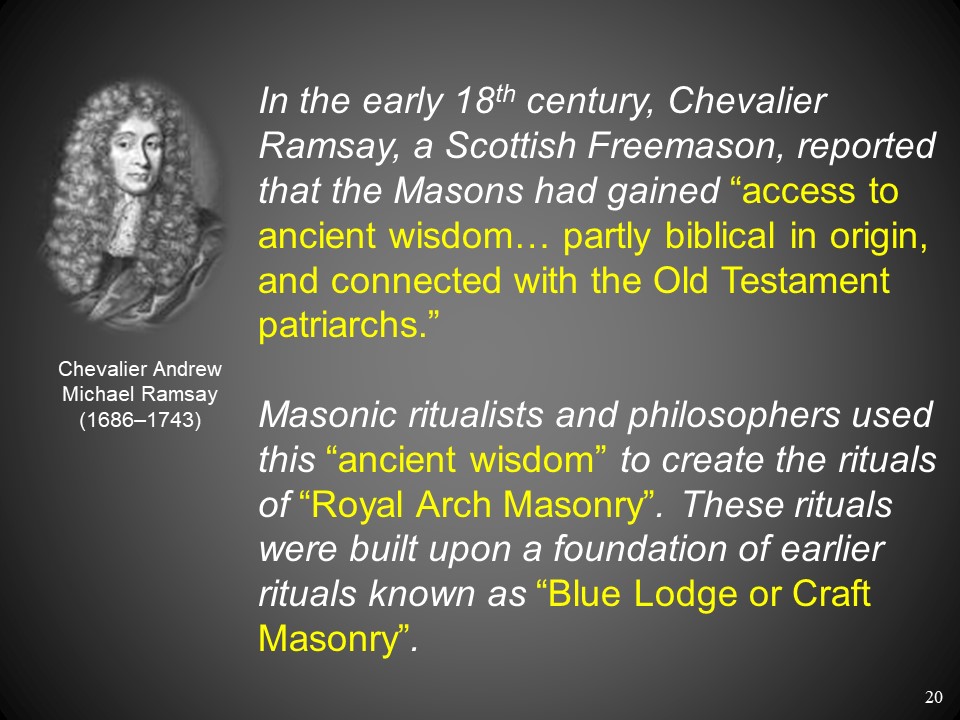
“It was Ramsay, in a speech to French Freemasons [‘Apology for the Free and Accepted Masons’], who suggested “that the Freemasons had access to ancient wisdom which was partly biblical in origin, and connected with the Old Testament patriarchs and the builders of the Temple, but which also reflected Egyptian and Greek mysteries, and other hidden secrets of the pagan world….He did not refer to the Masons of crusading times as a class of humble artisans but as ‘religious and warlike princes who wished to enlighten, edify and build up the living Temples of the Most High’…The apparent literalness of his earlier reference to the ‘Temple of Solomon’ has been dropped in favor of a transparent metaphor for nobility of character and aims.”